
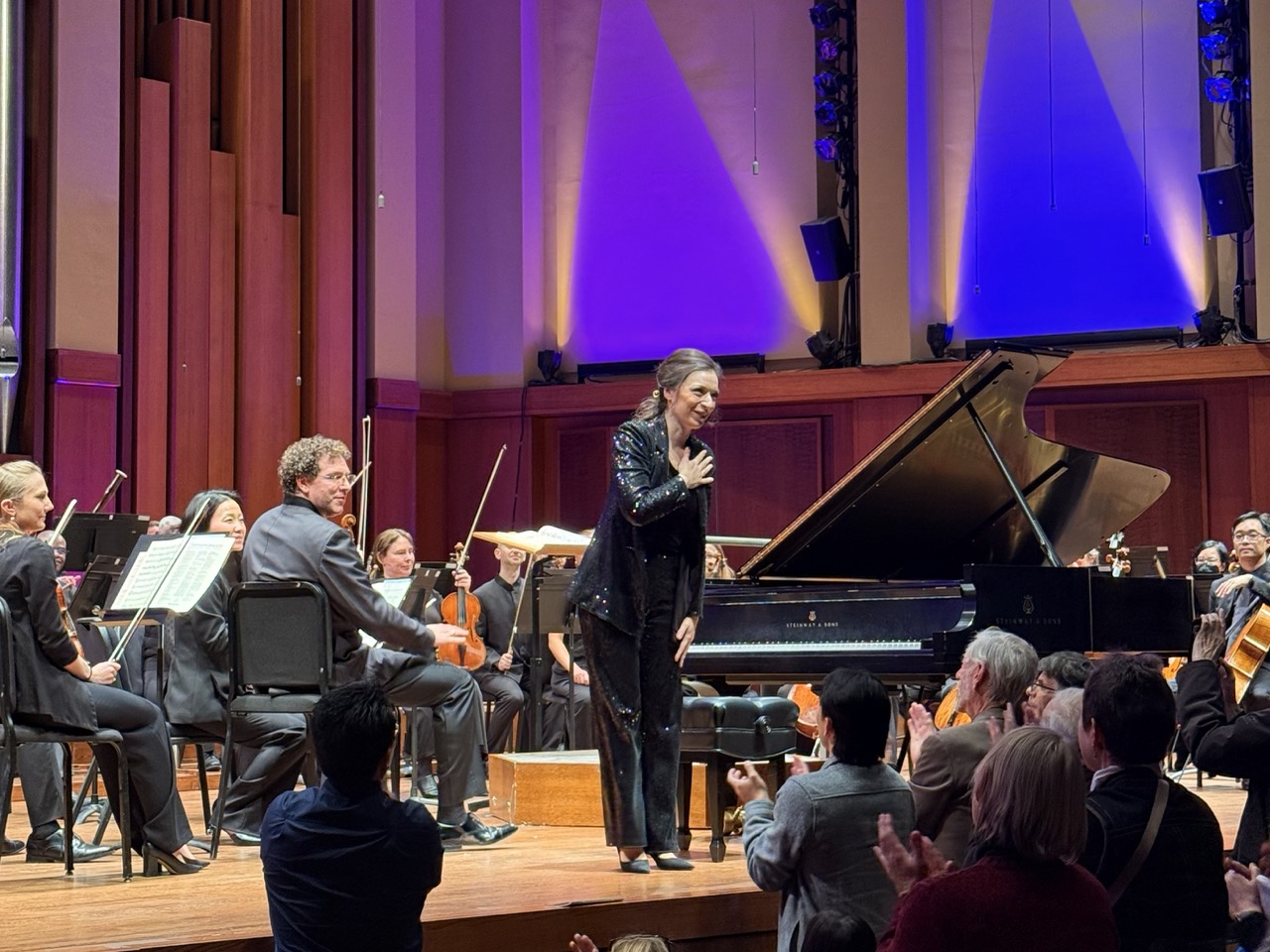
I recently went to the Seattle Symphony to hear Beethoven’s Piano Concerto No. 3 with Yulianna Avdeeva at the piano, followed by Bruckner’s monumental Symphony No. 4. As the orchestra tuned to the concertmaster’s A, part of my mind drifted back to a conversation I’d had the night before with Tory Trujillo, a healer and vocalist who uses sound as medicine. We’d been talking about how sound interacts with the body, not just through one’s ears but through one’s full body.
It’s tempting to say “the whole body hears,” but that’s not quite right. Scientifically, hearing is a very specific event involving the cochlea and auditory cortex. Most other tissues never send anything to the auditory system at all. And yet, claiming that only the ears matter for hearing is like claiming the tongue is the only thing that matters for eating. It’s myopic.
So how do other parts of the body respond to sound? They vibrate. Different tissues in the body respond to vibrations at different frequencies, similar to how a bottle will resonate or produce sound at a certain frequency when you blow air over it. The other tissues in our bodies, beyond the ears, don’t “hear,” but they do resonate.
You can find all sorts of studies that identify the resonant frequency of various body parts. There is huge variation because the differences in the density of tissues (bone, fat, muscle), the size (a femur vs. a toe’s phalangeal bone), and the interaction between the materials (the skull has comparatively little fat and muscle compared to a thigh). But the resonant frequency isn’t the only frequency that matters.
Yes, you’ll get the most movement when an object is subjected to a sound at its resonant frequency. But you get movement from a whole range of frequencies. That’s why you feel the bass in your chest regardless of key.
Beethoven, who composed some of his greatest works while losing his hearing, like his String Quartet No. 14, Op. 131, understood that experiencing sound went beyond hearing through the ears in a traditional sense. He would clamp a metal rod between his jaw, which was connected to the piano so he could feel the vibrations through his jaw and skull.
In our everyday lives we don’t separate hearing from feeling sound. We may comment that we can feel the bass in our chest, but it is all part of listening to the music. To isolate “hearing” from “feeling vibration” is to ignore how human experience actually works: integrated, multisensory, always richer and stranger than our tidy categories.
Both while sitting in Benaroya Hall before the symphony as well as lying on the floor at Tory’s sound bath, I wasn’t just hearing sound, feeling vibration, or watching performers. All of those signals braided together into a unified experience. My body, my attention, my history with the music, the atmosphere of the room, the people around me—everything combined.
Your entire body experiences music. The ears give you pitch and timbre; the body moves and vibrates; the mind interprets, responds, and imagines. Together they create something larger than either alone.
So the next time you’re before the symphony, at the club, or in a sound bath, don’t just listen, fully experience it.
If you are interested in experiencing sound like this and you live in Seattle, consider joining Seattle Performing Arts Lovers. We are a community of folks who love live performance in all its forms.