
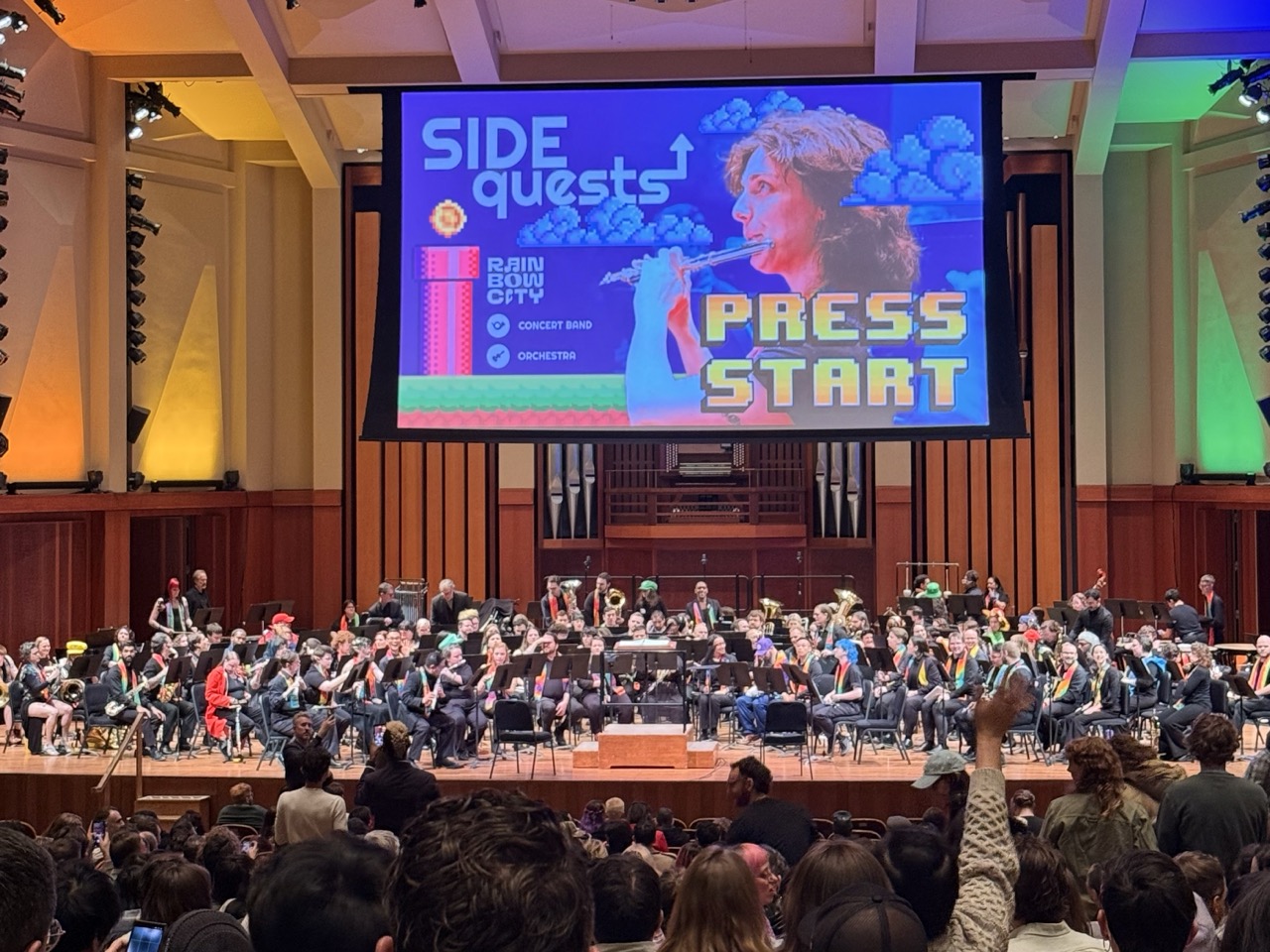
As a proud subscriber to the Seattle Symphony and Seattle Chamber Music Festival, I go to a lot of concerts. At these concerts, the contract between performers and audience members is straightforward. There are professional musicians creating music and an audience to listen. But at a recent performance by Seattle’s Rainbow City Community Orchestra and Concert Band, the stakes felt different: higher and more personal. I felt a nervous excitement. I was rooting for them: for the solos to shine, for the climaxes to hit, for the tech to work, for my friends performing to feel proud. It wasn’t a simple transaction of music produced, music consumed. The question of who the performance was for started to shift.
In the months leading up to the performance, I got glimpses of how the concert came together. I saw the time devoted to rehearsals. I heard about the pieces they love and those they could do without. I saw trips moved and calendars blocked to prioritize the performance nights. At parties it came up in conversation, making sure everyone got their ticket in time. By the time opening night arrived, it wasn’t just the performers who were invested in the concert.
The difference shows up in the concert hall too. The audience behaves less like spectators and more like participants. The dress is funkier, and often on-theme. While Seattle is already inclusive and accepting of all sorts of concert dress (t-shirt and shorts are not uncommon at a Seattle Symphony performance), themed outfits don’t happen. But at the Rainbow City video game themed concert, Side Quests, people dressed as Pikachu, Mario, and Luigi, to name a few. At the Seattle Men’s Chorus, you’ll see folks in drag and festive wear for the holiday concert. It becomes part of the show.
The participatory energy carries into the performance itself. At Rainbow City they brought two audience members on stage to play Tetris live as the musicians provided the backing music. The rest of the audience was oohing and ahhing during the down-to-the-wire game. I held my breath watching who would win. Both Rainbow City and Men’s Chorus gave us opportunities to sing along. I learned I still remember every lyric to the Pokémon theme song!
The concert’s most charged moment came with the premiere of Dawn Apart by Abel Lifshutz, one of the orchestra’s percussionists. In the silence before the conductor’s cue, the stakes felt unmistakable. Few people both write a piece and get to hear it performed by a live orchestra. I was rooting for them. My eyes welled up as I stood with the rest of the audience to applaud Lifshutz’s creation.
When I’m not singing along, I notice my attention drawn in new directions. At a professional concert, I lose myself in the sound, having a full-body experience. I’m listening for interpretation, thinking about the historical context. The music is the object of my attention. At an amateur performance, my attention shifts to the people. I find myself wondering what brought them here, who in the audience came to support them, how their parts land, what this means to them.
How much of this comes from knowing the performers? I’ve seen friends perform in both professional and amateur settings, and the feeling isn’t the same. The difference is in the kind of risk they’re taking. A professional is trained for this. They’ve devoted their lives to it. Their risks are about interpretation and execution. An amateur is stepping outside their comfort zone, sometimes at the edge of their ability. Getting on stage requires a different kind of vulnerability.
In truth, it’s not always perfect. You might hear wrong notes, rhythms out of time, and dynamics that lack range. And there’s always someone in your group willing to point it out. But the professionals err as well, maybe in a poorly chosen program or sterile performance. The mishaps become part of the intermission conversation.
To distill the difference, amateur performances emphasize community, participation, and celebration, while professional performances emphasize precision, interpretation, and the final result.
It’s not that one is better than the other. My experience of them is simply different and it likely is for you too.
Both amateur and professional performances ask something of you. If you’re a musician, join a community group or find an open mic. If a friend is performing, show up. As an audience member, your role is not to listen; you are participating.
In Seattle, there is no shortage of these spaces. To get you started, check out these fantastic opportunities to create or support community music: